Thursday, 14 November 2013

Feedback: Task 1 Audio-Only

Today I presented my audio-only piece to Debbie Ballin and my peers in an informal environment. Due to the inconvenience of my partner leaving the course without notice, I was placed at a significant disadvantage and as a result my piece was unfortunately unfinished. However, I do feel that the crit session was very useful. When working on my own, I often struggle as I have no second opinion on what "works" - as such, my ideas often get complex to the point where they are only understood by me. Receiving feedback from my coursemates and seeing their own pieces was inspiring and I feel it has set me on the right path for improving my own project. Below is a selection of points raised about my sound piece that I feel are valid, accompanied by a strategy for implementing these improvements before the deadline.

"The piece needs to be completed"
An obvious flaw in my presentation is that my sound piece was not complete, and thus did not give an accurate representation of my intentions and ability. To rectify this I will record the sonic elements I had not managed to capture in time, so as to complete my piece.

"The theme was not obvious"
Whilst several of my peers understood the concept, some did not identify the theme until after I had explained my intentions. I feel to rectify this I need to take focus away from the sins themselves by adding a more Hellish ambience - low murmurs, growls etc. This will hopefully work co-operatively with the sinful and atmospheric sounds to convey the location of Hell. Another suggestion I was given was to include excerpts of the poem, however I feel this approach is too literal and as a result I shall not pursue this.

"The piece does not flow"
Due to the segmented nature of my piece, there are several instances where the soundscape switches to something entirely different. Although I did make use of faded transitions, my peers and Debbie in particular feel that the piece should have more continuity. As a result, I intend to include a Hellish ambience (as mentioned above) throughout the whole piece, as well as introducing the next circle more gradually.

"The piece is too structured"
As I knew already that I intended to take a structuralist approach to my film, and had a very clear vision in my head as to how the finished product would look and sound, I implemented structuralist techniques such as repetition and rhythm into my piece. Unfortunately, this had a negative effect on its overall quality and made it seem poorly-made and amateurish. My peers felt it should have a more natural sounding ambience as this project is sound-only, and Debbie suggested that if I needed to re-implement the structuralism for the film piece I could make two separate soundtracks. I think this is a very good idea, so I will make this piece less structured and give it a more natural rhythm. 

As well as this criticism, my peers also provided me with elements of my piece that they enjoyed and thought I had done well. Positive feedback on my piece includes:

  • The sounds were clear and well-recorded.
  • There was a large variation in the types of sounds used.
  • The piece was interesting and maintained the audience's attention.
  • Some elements of the piece were shocking and unexpected.
  • The concept was creative, unique and well thought-out.

Using this positive feedback, I know what elements resonated with my audience and so I can build on them further on in the project. It also implies to me that the soundtrack is strong enough in terms of detail on its own, and so perhaps my film should be less detailed and more abstract. Overall, I found the critique and feedback from Debbie and my peers very helpful. It has motivated me to continue working hard on the project and has given me confidence in my own creativity. 

______

After applying the changes suggested in my crits session, I feel I have reached a point where my audio piece is complete.


Tuesday, 12 November 2013

Project: Editing for Task 1 Audio-Only

Today I have been editing my sound piece for my Task 1 Audio-Only project. My lecturer was ill and so I had all day to work on the piece, which was sufficient time to get a solid, structured sound piece composed. However, I intend to return to the Apple suite tomorrow to do a few last minute tweaks and corrections in time for my presentation on Thursday.

As I already know that I am taking a structuralist approach to my experimental film, I decided to also implement this technique to my sound piece. I had a clear vision of how the film would look in my head, so this helped me to compose the rhythm of the piece and incorporate the elements of repetition I desired.

I split the three minutes stated in the brief into nine twenty-second segments, each one representing a different circle of Hell and making use of the sounds I had recorded for that environment. I feel that this has worked well as my piece constantly evolves and changes, making it interesting to listen; I believe it will hold the attention of the audience and surprise them at points. I especially like how the piece becomes more twisted and sinister over time: beginning with a calm stream and progressing through a storm to a fiery torture chamber, as I feel this captures the idea of going deeper into Hell I am intending to represent. 

Unfortunately, the piece was not finished as I was missing some sounds that I was unable to record. Because of this, some segments of the piece sound bare in comparison and the final segment is completely empty. I fear this will reflect badly on the piece when I present it but I do not have sufficient time to rectify this error, and so instead I shall explain my situation to my peers during the presentation. 

Overall, I feel the piece is quite successful, however I am slightly disheartened by the way it has turned out compared to my vision. I am also concerned that, whilst the soundtrack works in my head as I am matching it to the film, it may not resonate with an audience who cannot see the visual elements I have planned. I am hopeful that with more time and by implementing the feedback I will receive on Thursday, I will be able to improve my piece and get it to a standard I am satisfied with. 

Sunday, 10 November 2013

Project: Recording for Task 1 Audio-Only

Yesterday, I spent the day back in my hometown. What was originally intended to be a casual visit to my mother became a last-minute drive to record as much sound as I could for my ambitious project, due to the situation I had been left in.

I opted to use a Zoom H4N to record sound with. I was attracted to its versatility and high-quality recordings, and knew that it would be a key tool for this part of the project. I used an AudioTechnica  directional mic to ensure that my recordings were as clear and free of background noise as possible. I also used an Aquarian Audio H1A hydrophone to capture some underwater sound, as I knew this could make an effective underlying ambience for the piece. I feel that I chose my equipment wisely as I had been taught how to use it in my Production Skills classes, meaning I was familiar with their various functionalities and how to operate them.

Overall it was moderately successful. I managed to record most sounds that I required, even if it meant improvising. For example, I rustled sweet wrappers found in my brother's bedroom to create a convincing sound of a crackling fire, and used an umbrella to capture the sound of Satan's wings for the ninth circle.
Sweet wrappers make a convincing substitute for a crackling fire

I had to be inventive in other areas, too. For example, I needed the sound of mud squelching for use in the third circle of Hell. In order to capture this, I went across the road and gathered some dirt from the park. I added water gradually (to avoid the mud getting too wet and producing an inadequate sound) until it sounded thick and sloppy, and then volunteered my stepdad to place his foot into the bucket. I made use of my parents in other areas, too: getting them to hold the equipment for me in absence of my partner. They were also kind enough to lend their vocals for the screaming, shouting and gurgling sounds I required.

Recording the metallic sounds of knives for the 8th Circle

Unfortunately, there were some sounds I failed to capture or recreate. For example, whilst I was able to use a recording of the strong winds I caught in Edale, I was unable to capture any rain or thunder due to the weather. As a result, I had to source these sound effects from royalty-free website Freesound.org. I also used this website to locate stock orgasms as these sounds were not appropriate for my parents to recreate, however I am interested in the possibility of recording online pornography to substitute this download. Another issue I faced was the final circle of Hell, which is very icy. I have struggled to think of sounds that sound 'icy', so I feel like it may be best to combine strong winds with shivering and the tinkling of glass.

Regardless of any difficulties I faced, I feel much better about the project after capturing some solid sound clips and I feel excited about the editing process.

Friday, 8 November 2013

Analysis: "Dante Quartet"

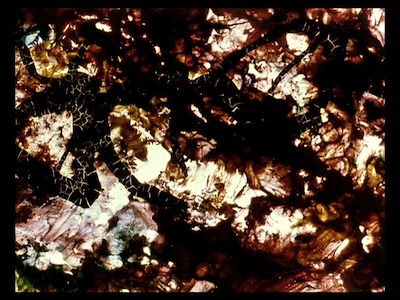
Dante Quartet is an experimental film made by Stan Brakhage in 1987. It uses the technique of hand-painted film to represent the afterlife through colour and shape. It famously took Brakhage over six years to complete, as he painted each frame in the six-minute piece himself.

Hand-painting film is a very interesting technique, as it forces the artist to discard traditional image in favour of colour, shape, tone, speed, light and other formal elements. This provides a challenging but potentially rewarding method of communicating moods, feelings and ideas. For example, during the Hell Itself section of Dante Quartet, Brakhage uses harsh, dark colours to represent evil, pain and suffering. However, during the Purgatory segment of the film, he uses brighter colours like blue, yellow and green, which are connotative of nature and thus feel more positive.

A comparison of the difference in tone, colour and shape in Dante Quartet

I am inspired by the way this film does not rely on solid image to convey meaning or feeling. I feel that the abstract approach it has taken is inspiring for its bravery and ambition, as well as its successful execution, as audiences feel the moods he is attempting to convey. I am also inspired by the segmented nature of the piece, and how the feelings and imagery changes with each section.

The inspiration drawn from this piece is very relevant to my own project, as both Brakhage and myself have been inspired by Dante Alighieri's Divine Comedy, however I have chosen to focus on one section of the poem and represent the various environments within Inferno. As my soundtrack is so literal and detailed, the idea of having a more abstract approach to my experimental film is very appealing. However, I feel that the piece may be a little too abstract at points, so I am interested in finding a happy medium between the abstract and the literal, perhaps in the style of Ballet Mécanique. I am still confident that I want to take a structuralist approach to the film, but I am now interested in incorporating abstract or Dadaist elements. 

Development: Task 1 Audio-Only

For the audio-only brief of Task 1, we are required to create a soundtrack that captures a sense of place. I intended to use a classic, Renaissance-era painting such as Sandro Botticelli's Nascita di Venere, and create the sounds I imagined would be heard within the fictional scene of the painting. I was interested in this idea as it brought the sense of hearing to an image, which is usually only intended for the eyes.

Venus is born from the ocean in Sandro Botticelli's Nascita di Venere

Unfortunately for me, my partner was less enthusiastic about the idea. She wanted to create something darker and more hard-hitting, whereas my idea was more orientated towards beauty and concept. Preferring to have both of us onboard for the project than to force her into creating something she was not passionate about, I opted to go with her idea despite my reservations, as I was confident I could bring my own experimental touch to it.

My partner has since left the course, leaving me with total creative control over the project. However, due to the impractical timing of her departure, I feel it would be counter-productive to revert to my initial idea. As such, I am continuing with the theme of Hell for my Task 1 project. However, after hearing the song Poetry In Motion on a TV advert, I was inspired to explore the possibilities of using classic Renaissance poetry for inspiration as opposed to the paintings I had considered earlier.

This was the defining moment at which the previously ambiguous concept began to take a definitive shape. I was naturally drawn to Dante Alighieri's Inferno segment from his epic poem Divine Comedy, as it is arguably the most frequently alluded-to depiction of Hell in popular culture, so it seemed like a good place to begin. I began to explore to idea of 'the nine circles of Hell' that Dante visits in the poem and the potential to capture a sense of each of these very different environments. The task was somewhat daunting given my limited timescale, but after discovering that the poem had inspired Botticelli himself to paint Dante's vision of Hell, it felt as though I had connected the last dot, and to discard the idea would be an injustice to the project and my initial vision.

Dante Alighieri's Inferno as imagined by Sandro Botticelli

Tomorrow I am going home for the weekend. I have booked out the necessary recording equipment with the intention of recording the necessary sounds I will need to create my sonic interpretation of Dante's Inferno. I have chosen to take a more surreal approach to representing each circle - as a result, I will use sounds that are representative not only of the environment, but also the sins that its inhabitants committed to get there.

I have decided on taking a structuralist approach to my soundtrack and subsequently my film. I have made this decision as I wish for my piece to reflect its poetic inspiration, and I feel that structuralist experimentation would provide an array of opportunities to experience with rhythm and verse-like segments. I intend on splitting my three minute piece into nine twenty-second segments, each one representing a different circle and comprising of various sounds listed below. The following list is relative and not definitive.

SOUNDS NEEDED
Circle 1: river, birds
Circle 2: strong winds, thunder, sexual moaning
Circle 3: rain, squelching mud, chewing, burping
Circle 4: rock dragged along ground, grunting, coins jingling
Circle 5: splashing, shouting, gurgling, thumping
Circle 6: muffled screaming, muffled fire, banging, religious preacher
Circle 7: screaming in pain, fire, boiling liquid
Circle 8: whipping, knives, fire, screaming
Circle 9: shivering, beating of wings, general iciness

Thursday, 7 November 2013

Analysis: "Interval"

Interval is an experimental short film made by Peter Greenaway in 1969. It focusses heavily on rhythm and cutting and is a good example of how simplistic film can still be very effective and thus, in a way, quite complex.

A still from Interval, just before a cut

My favourite thing about this piece is the relation between image and sound, executed through the means of cutting. As images are shown on screen, they cut in time with whatever rhythm is being played - be it a metronome or a recital of the alphabet. This is very effective on a visual level, as it is at first very surprising to the audience. Although the novelty wears off as viewers become accustomed to the rhythmic nature of the piece, the cutting still serves as a good device for creating enigma and keeping the audience interested. When it cuts away, pieces of the 'narrative' are omitted, and the audience is left wondering what happened in the space in between; even if the action seems mundane.

I am very inspired by the cutting-to-rhythm style of this piece, and feel it would work very well as a structuralist technique used in my own film. It has provoked me to consider using a similar technique, but alternating between shots - each shot cutting into the action of the shot before, and then vice versa. I do feel, however, that at times the structure of this piece was not executed smoothly or in a disciplined fashion, which does not appeal to me. I feel that when taking a structuralist approach it is important to follow the rules you have set yourself, and so I will ensure I do this in my own project.

Analysis: "(nostalgia)"

(nostalgia) is a short-form experimental film by Hollis Frampton. It was released in 1971 and has become a classic example of avant-garde film; in 2003, it became preserved in the United States' National Film Registry on the grounds that it was 'aesthetically significant'.

The film features a voiceover reflecting over some of Frampton's earliest photographic work, whilst onscreen the images are burned atop a heat plate. The sound and images are not unified; instead, the narrator describes the photograph that is next in line to be shown, whilst the image he has just finished discussing is incinerated. This experimental technique is repeated throughout the entirety of the films thirty-eight minutes. For this reason, it can be said that, with (nostalgia), Frampton adopts a structuralist approach to the art of avant-garde filmmaking.

A still from Frampton's (nostalgia) showing the burning of a photograph

This film has resonated with me significantly and I am intrigued by the disciplined fashion in which the film has been made. I am also interested in the discipline that the audience must undertake in order to watch the film, which (due to its repetitive nature and monotonous voiceover) may prove tedious for some audiences to watch. I feel like this assumption was confirmed by the reaction of my peers after watching the piece. I particularly feel like this technique would prove effective when used in my own film: as my subject matter is Hell, it seems fitting that my audience be exposed to a film they may find tedious to watch, as it reflects the disciplinary and punishing connotations of Hell.

This film has inspired me to use repetition and structure to capture the feeling of punishment and discipline.